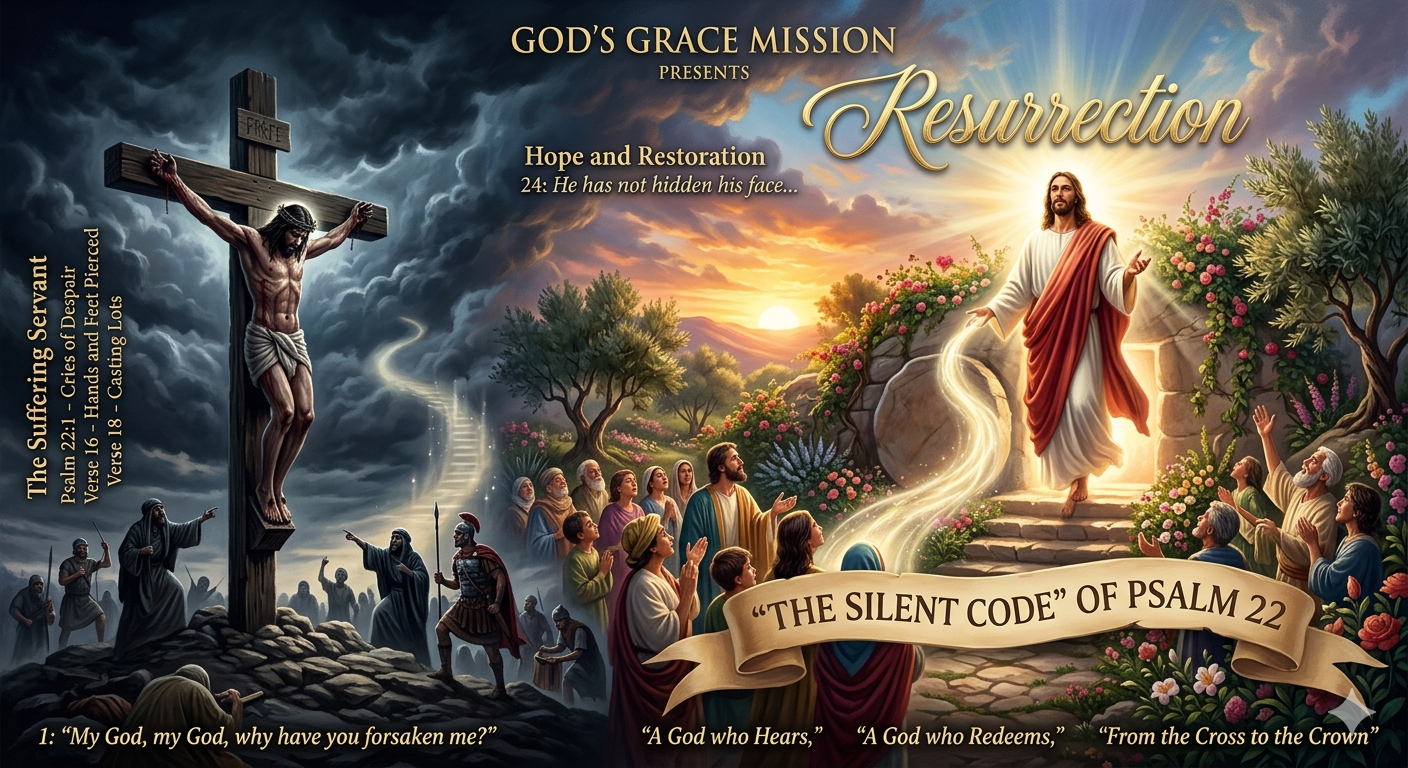
The transition from David’s cave to the Cross is perhaps the most famous “decoding” in history. Psalm 22 starts with a cry of abandonment but ends in a victory shout, effectively bridging the gap between a suffering King (David) and the suffering Messiah (Jesus).
When Jesus cried out, “My God, my God, why have you forsaken me?” (Matthew 27:46), he wasn’t just expressing pain; he was quoting the first line of Psalm 22. To a Jewish audience, quoting the first line of a Psalm was like providing a hyperlink to the entire “file.”
1. The Paradox of Absence
The “code” here is the feeling of God’s silence. David feels like the Clockmaker has finally walked away.
- The Text: “I cry out by day, but you do not answer” (v. 2).
- The Reality: Even in the silence, David continues to address God as “My God.” The Gardener is still there; He is just working in the dark.
2. The Graphic Accuracy
Written roughly 1,000 years before the Roman invention of crucifixion, the Psalm contains chillingly accurate details that “decode” the physical reality of the Cross:
- Verse 16: “They pierce my hands and my feet.”
- Verse 18: “They divide my clothes among them and cast lots for my garment.”
- Verse 14: “I am poured out like water, and all my bones are out of joint.”
Moving from “The Clockmaker” to “The Gardener”
The shift in the Psalm happens at Verse 21. Suddenly, the tone flips from a funeral to a feast.
| The Agony (vv. 1–21) | The Victory (vv. 22–31) |
|---|---|
| “I am a worm and not a man.” | “I will declare your name to my people.” |
| Surrounded by “bulls” and “dogs.” | “All the ends of the earth will remember.” |
| Feeling forsaken/ignored. | “He has not hidden his face from him.” |
Why this matters for the “Silent Code”:
This Psalm “decodes” the idea that God’s silence is not God’s absence. * When David was being hunted, he felt ignored—but he was being preserved for the throne.
- When Jesus was on the cross, it looked like the Clockmaker had left—but the Gardener was actually planting the seed for the ultimate “growth” (the Resurrection).
The Deepest Secret: The “Silent Code” tells us that God is most involved exactly when we feel He is most distant. He isn’t watching the tragedy from a distance; He is the one enduring it with the sufferer.